Hello folks,
Kai here. Last time Benjamin showed you his drum kit and already gave you a bit of an insight into our live gear. Today I will continue with it and try to explain a bit of why and how we use our gear.
The whole thing is separated into 2 parts:
- Part 1 is a brief history of our rack and shows you the development of our system.
- Part 2 is going to be the rundown of our current rack.
So, without further ado, let’s start with part 1:
Parasite Inc. live rack Pt. 1 - Evolution
From the very first day samples and synthesizers were an important part of the sound of our band. In the very beginning we also planned to find a keyboard player but with the variety of sounds (and mostly a lack of keyboard players in our area) this plan led into a dead end and for the first years we were forced to play the songs without these elements.
In the beginning we also didn't care much about our sound on stage and it took us some time to understand and value how in-ear monitoring, well-tuned instruments and a thought-out setup can improve the whole live experience for the band and the fans.
Somewhere around the recording of Time Tears Down we started this journey on a small budget and below you can see a very first version of our rack. We shared one cheap in-ear transmitter for all band members. There was an Alesis DM5 for the kick trigger and a cheap headphone preamp that did some very simple mixing of the kick and backing tracks. We used an iPod with a stereo track - left side was the metronome track and right side were mono backing tracks.
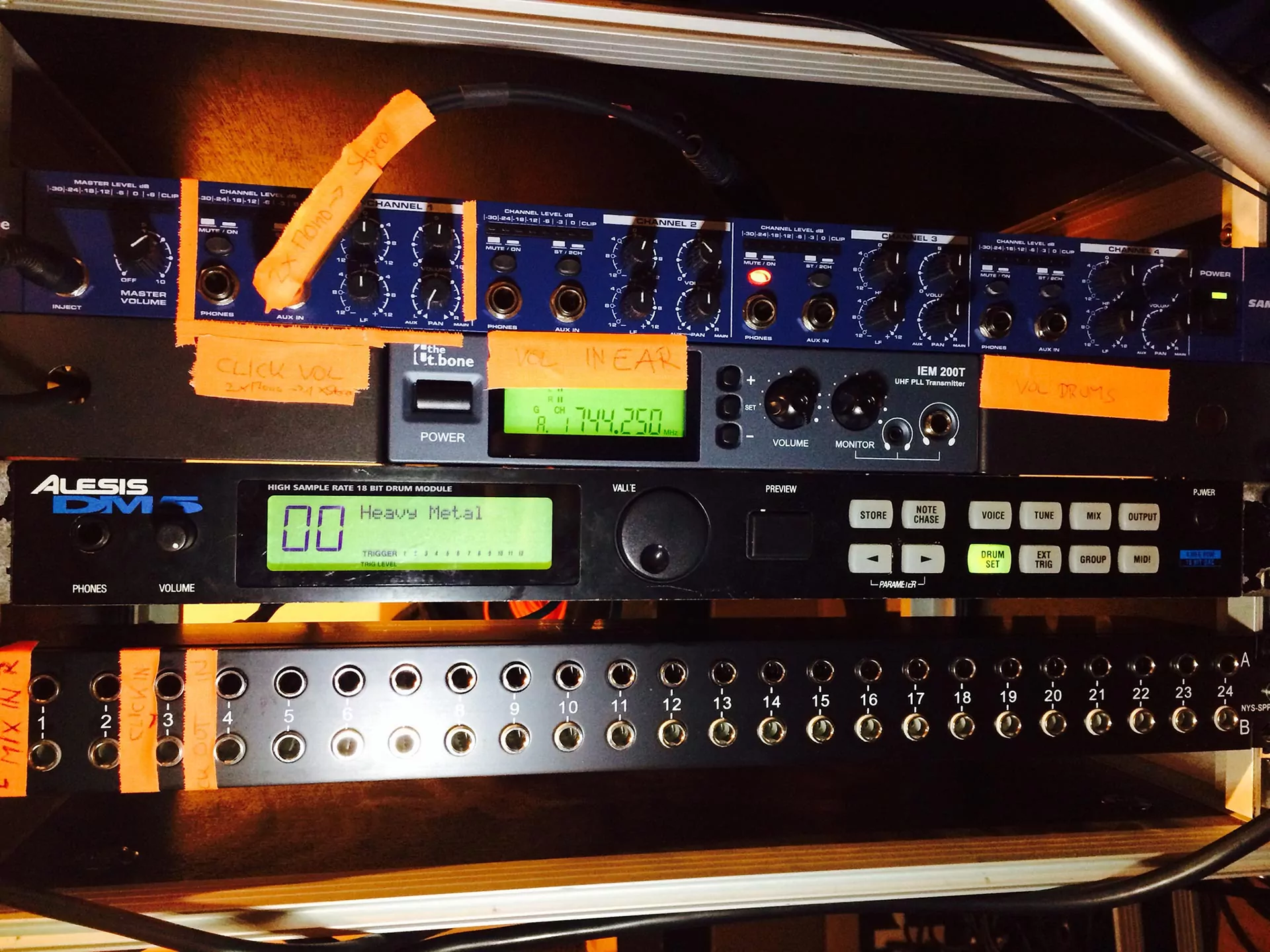
For the first time we had the full support of keyboards on stage, a clearer stage sound and no ear ringing after the show. While this first setup was a kind of can opener to what could be possible, it had some downsides like no personal in-ear mixing and cheap pumping preamps.
Below is an image of version no. 2 which was used until 2014. This version allowed at least Benjamin to have a personalized in-ear mix because, as you can imagine, behind the loud drum kit things run totally different compared to the rest of the band. I think it was 2014 when we also switched from tube amps to Axe-Fx.
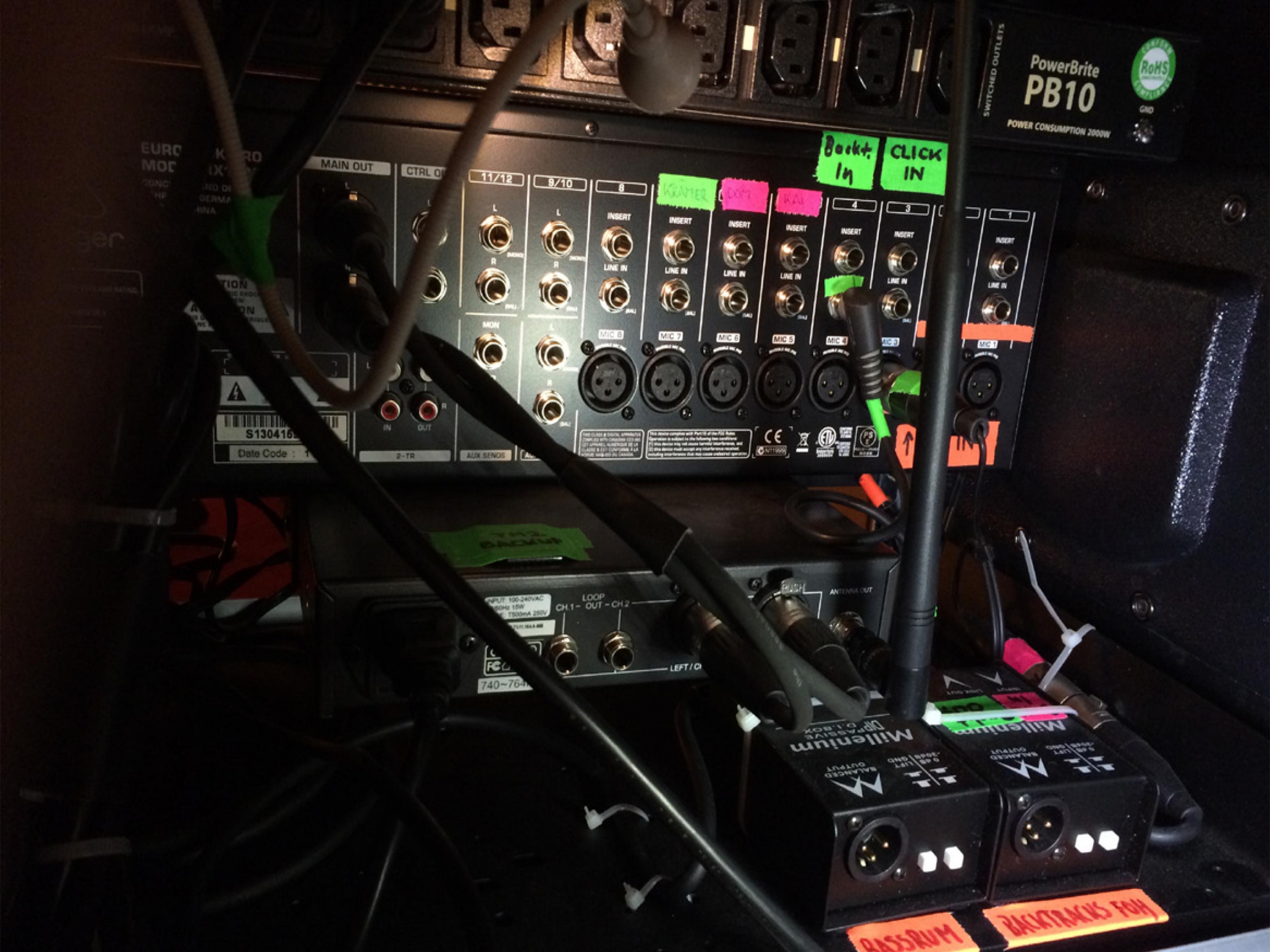
Live rack 2014
back
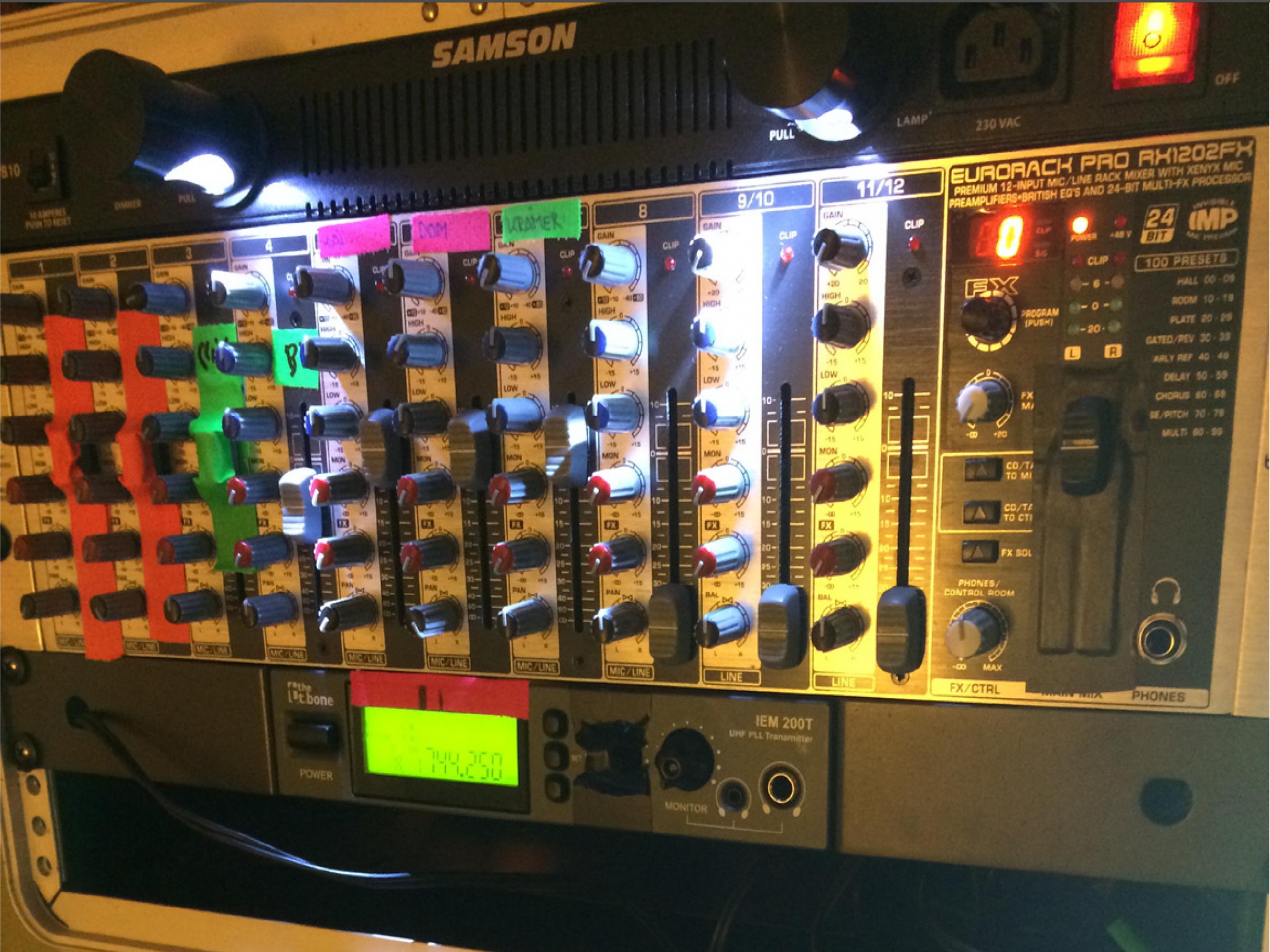
Live rack 2014
front
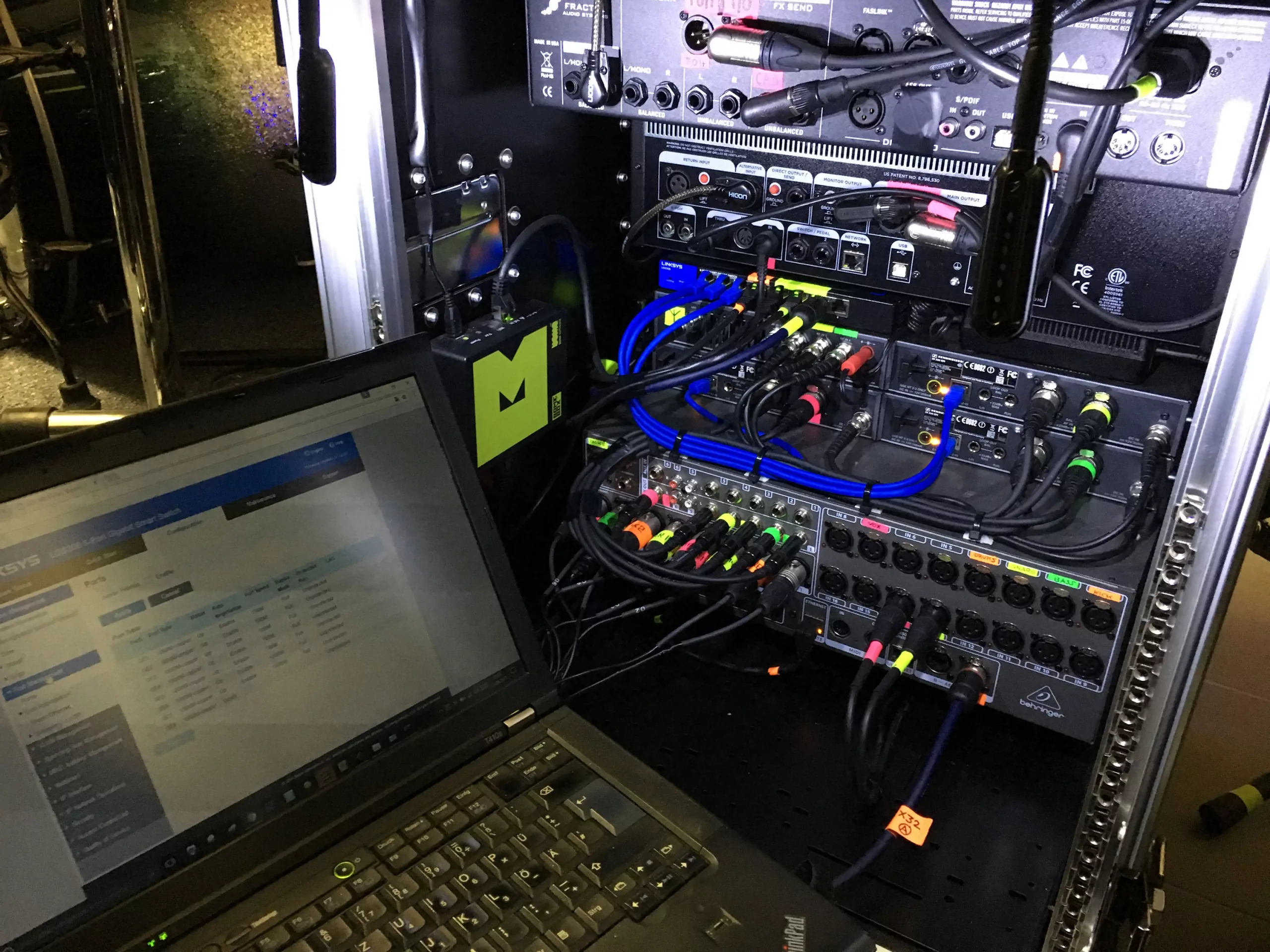
In 2015 we were finally able to invest into some better gear and extended the whole rack into two cases, added two Sennheiser EW 300 G3 in-ear systems and the Behringer X32 Rack for extended signal routing. Around that time we also started to use a laptop for the backing tracks.
Especially the Behringer X32 Rack was a game changer for us (and many other bands). Years ago, good in-ear monitoring racks were awfully bulky and expensive boxes. The X32 changed it all: suddenly bands had the chance to have a compact mixing console with usable preamps, effects and flexible routing in a small space for a good price. Even today it’s still one of the best ways to get into in-ear monitoring.
As a side note: The cases we used and still sometimes use were made by a Finnish company that also built cases for Wintersun. The reason for that were the special doors that, unlike normal rack doors, are integrated into the rack and can’t break open easily while also making the cases smaller and lighter.
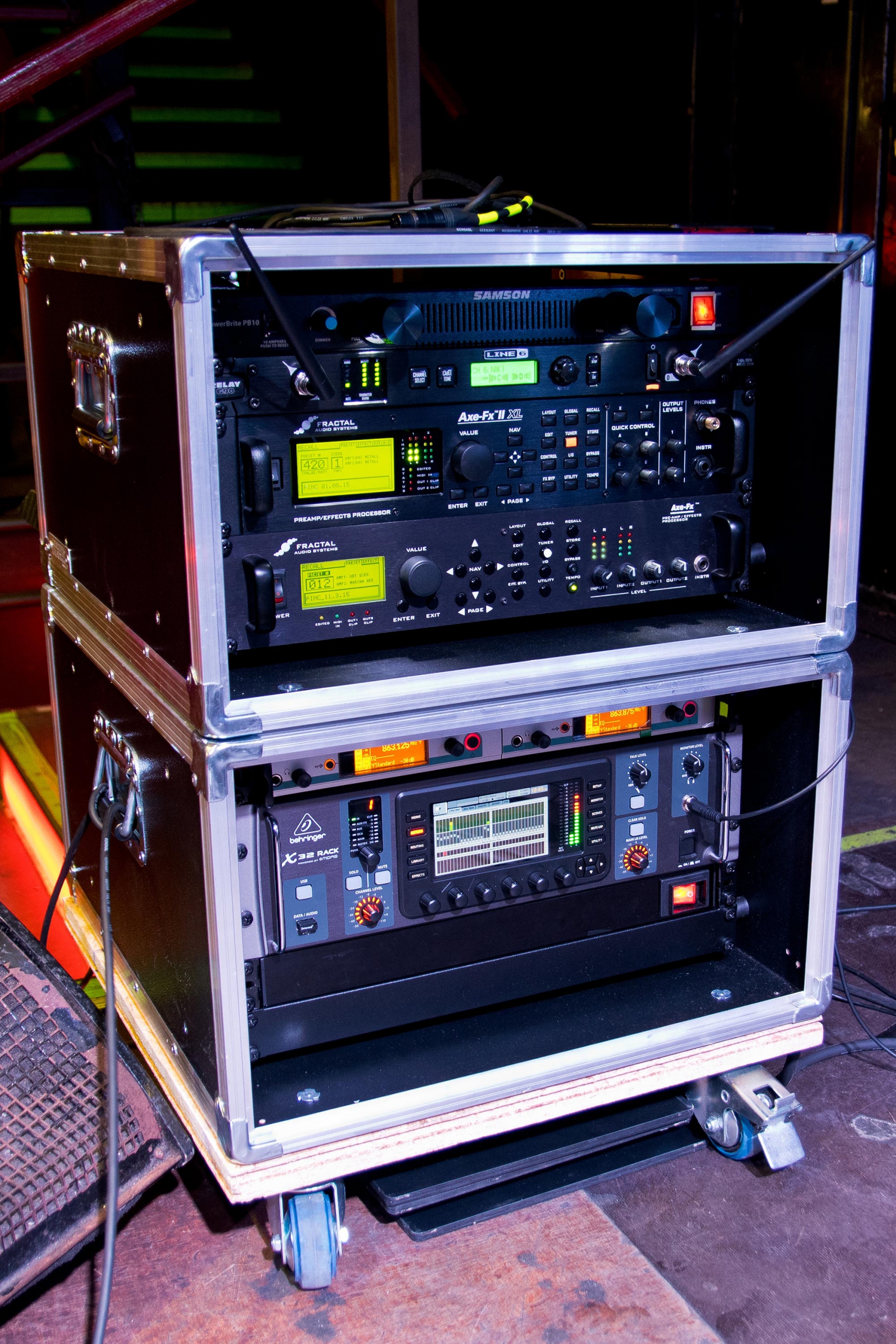
Live rack 2016
front
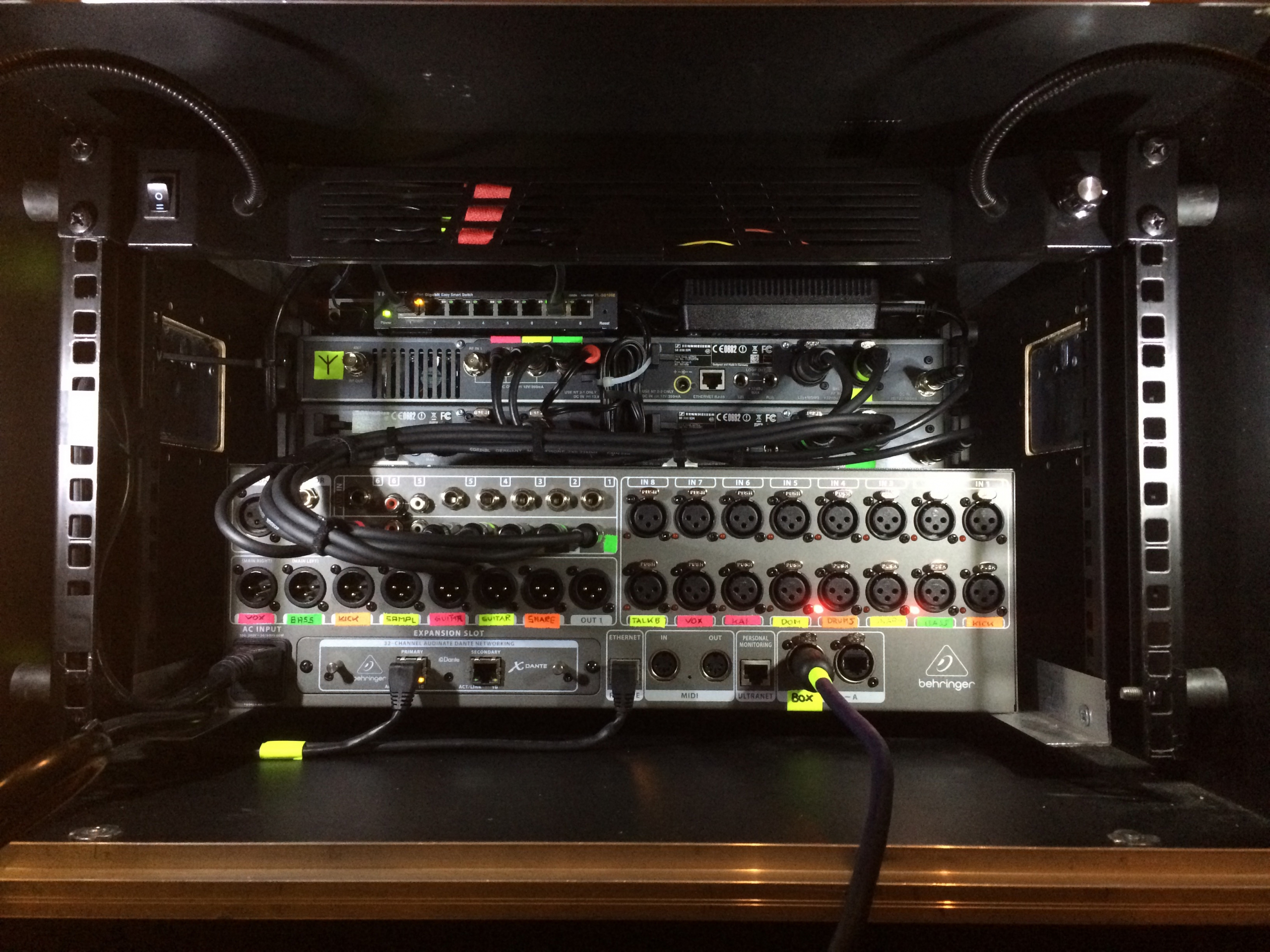
Live rack 2016
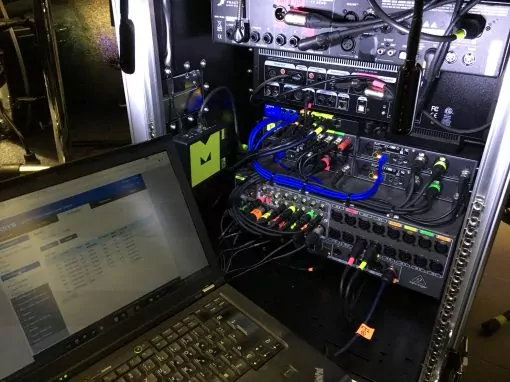
Back of the system when we extended the in-ear-monitoring to each band member and added audio over network via Dante for backtrack playback from our laptop
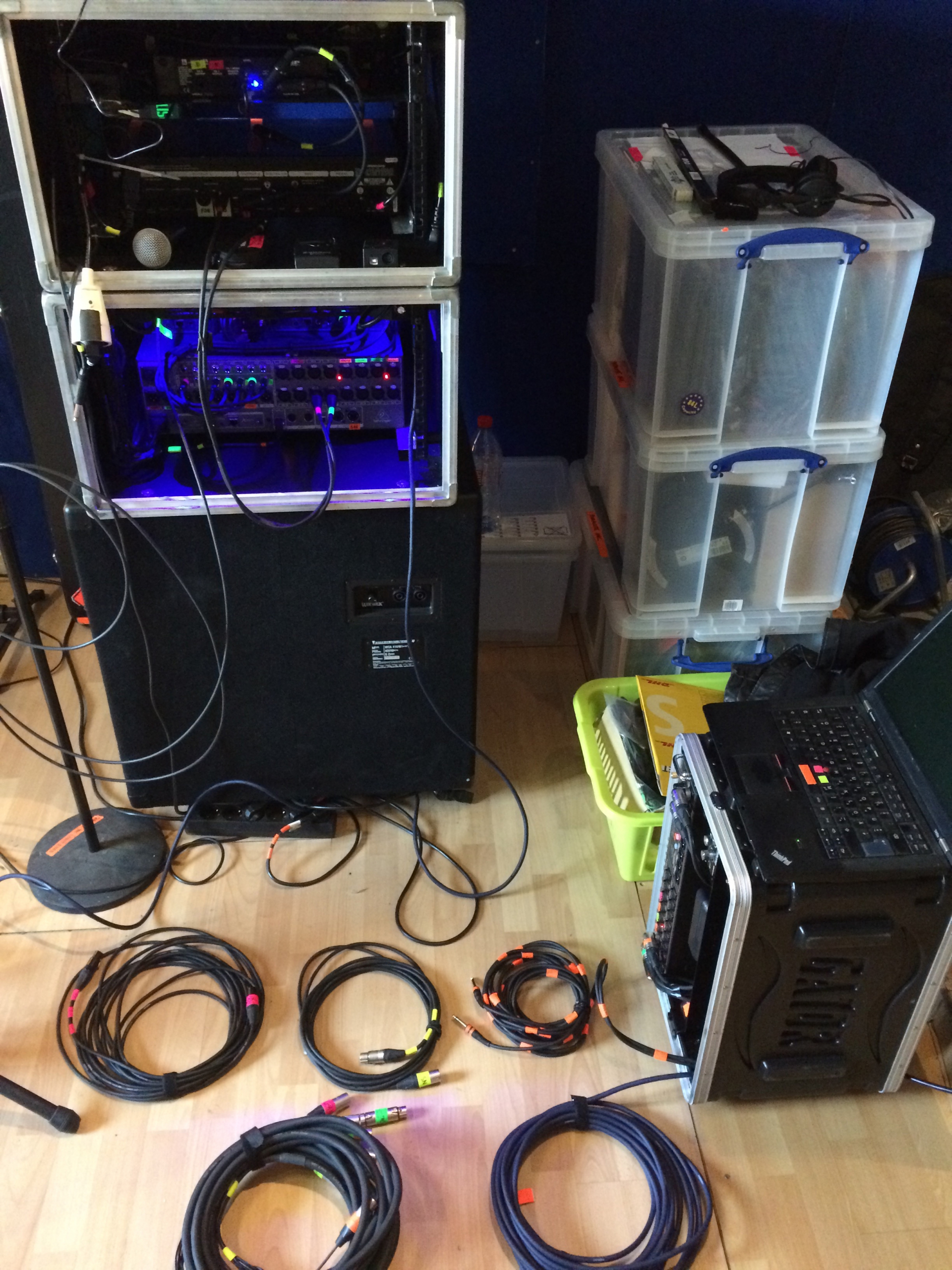
Live rack 2016
3 racks solution
In 2016 we started to switch from Axe-Fx to Kemper, added DMXIS light controlling (a small box that lets you control lights via MIDI from the DAW), another Sennheiser EW 300 G3, a Sennheiser AC3 combiner and an A1031 antenna. We also added a third rack with another X32 for signal exchange between the main racks and the drum riser.
While the whole system basically worked fine and delivered everything we needed, it eventually became too big and complex. Around 2017 we started to rethink the rack into what has now become version no. 4.
It’s roughly based on the following requirements:
- consistent stage sound
- reduce instrument bleed
- make the rack as small as possible
- use as few cables as possible
- collect and route signals from all instruments
- wireless in-ear monitoring and instruments for bass and guitars usable in as many countries as possible
- possibility to send all signals to the FOH engineer via Waves Soundgrid, AES50 or analog XLR
- automated light show and amp sound switching
- easy adjustment of the drum monitor mix
- hardware backing track player with the possibility to add or remove instruments
- redundancy (still on the to-do list)
Based on these requirements we are still tweaking and improving our system.
In part 2 we'll show you our current live setup and how it has improved since the solution we used until 2017.
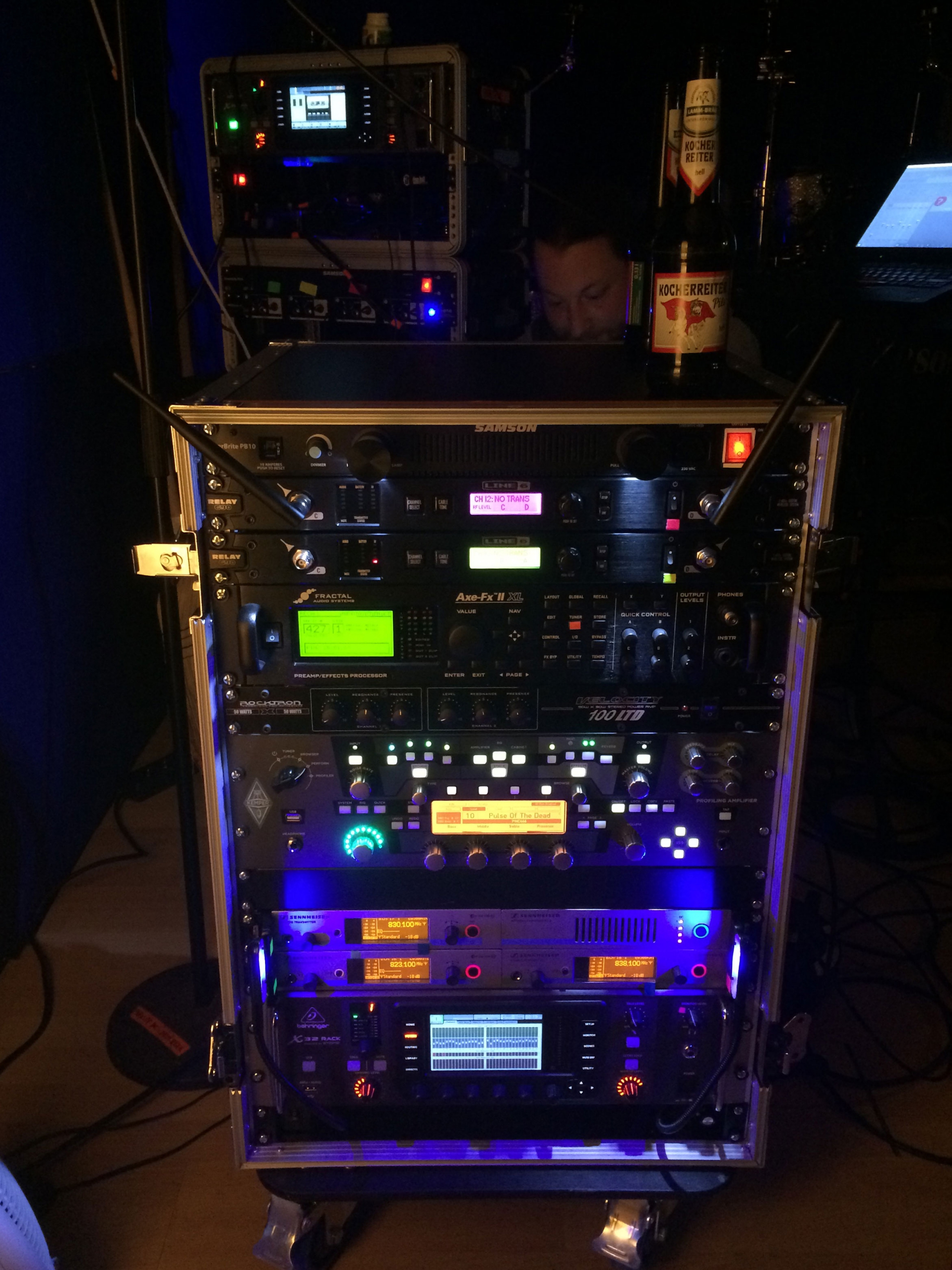
Live rack 2017
redesign to an all in one solution
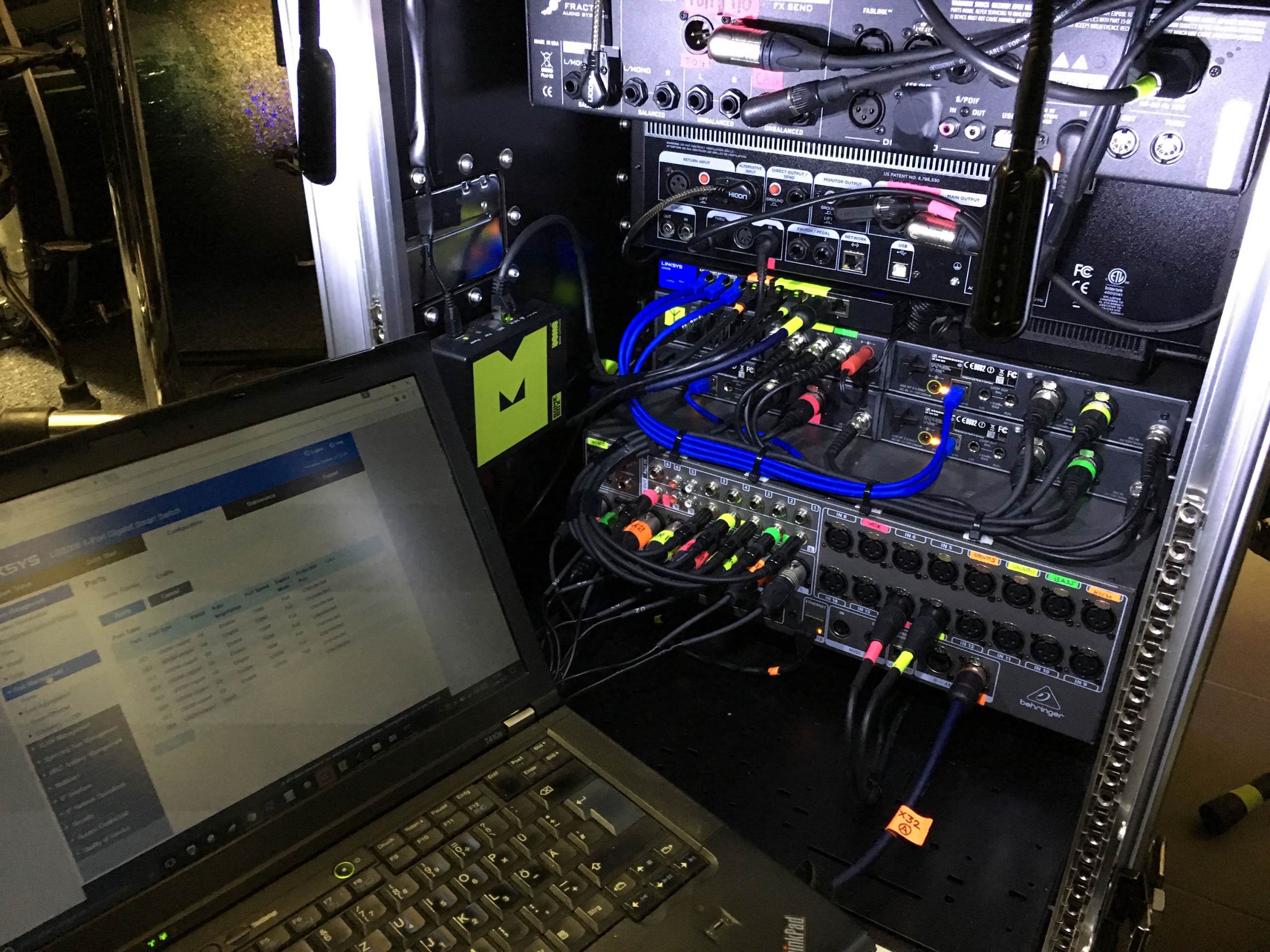
Live rack 2017
redesign to an all in one solution